

What Are Two Types Of Bones Based On Cellular Makeup
| Os | |
|---|---|
 A bone dating from the Pleistocene Water ice Age of an extinct species of elephant | |
 A scanning electronic micrograph of bone at x,000× magnification | |
| Identifiers | |
| MeSH | D001842 |
| TA98 | A02.0.00.000 |
| TA2 | 366, 377 |
| TH | H3.01.00.0.00001 |
| FMA | 5018 |
| Anatomical terminology [edit on Wikidata] | |
A os is a rigid organ[1] that constitutes part of the skeleton in almost vertebrate animals. Bones protect the various other organs of the trunk, produce cherry and white blood cells, store minerals, provide structure and support for the body, and enable mobility. Bones come in a variety of shapes and sizes and have a complex internal and external structure.[ii] They are lightweight still potent and difficult, and serve multiple functions.
Bone tissue (osseous tissue), which is likewise called bone in the uncountable sense of that discussion, is hard tissue, a type of specialized connective tissue. Information technology has a honeycomb-similar matrix internally, which helps to requite the bone rigidity. Bone tissue is made up of different types of os cells. Osteoblasts and osteocytes are involved in the formation and mineralization of os; osteoclasts are involved in the resorption of os tissue. Modified (flattened) osteoblasts become the lining cells that course a protective layer on the bone surface. The mineralized matrix of bone tissue has an organic component of mainly collagen called ossein and an inorganic component of bone mineral made up of various salts. Bone tissue is mineralized tissue of two types, cortical bone and cancellous os. Other types of tissue found in bones include bone marrow, endosteum, periosteum, nerves, blood vessels and cartilage.
In the man trunk at birth, there are approximately 300 bones present; many of these fuse together during development, leaving a total of 206 separate basic in the developed, non counting numerous small sesamoid bones.[three] [4] [5] The largest bone in the body is the femur or thigh-os, and the smallest is the stapes in the eye ear.
The Greek word for bone is ὀστέον ("osteon"), hence the many terms that utilise it every bit a prefix—such as osteopathy.
Structure [edit]
Os is not uniformly solid, simply consists of a flexible matrix (about 30%) and bound minerals (almost 70%) which are intricately woven and endlessly remodeled by a grouping of specialized bone cells. Their unique composition and blueprint allows basic to be relatively difficult and potent, while remaining lightweight.
Bone matrix is 90 to 95% composed of rubberband collagen fibers, also known as ossein,[half dozen] and the rest is ground substance.[seven] The elasticity of collagen improves fracture resistance.[8] The matrix is hardened past the bounden of inorganic mineral salt, calcium phosphate, in a chemical arrangement known as bone mineral, a course of calcium hydroxylapatite. It is the mineralization that requite basic rigidity.
Os is actively constructed and remodeled throughout life by special bone cells known as osteoblasts and osteoclasts. Inside any single bone, the tissue is woven into two main patterns, known as cortical and cancellous os, and each with different appearance and characteristics.
Cortex [edit]

Cross-section details of a long bone
The difficult outer layer of basic is composed of cortical bone, which is also chosen meaty bone every bit it is much denser than cancellous bone. It forms the hard outside (cortex) of basic. The cortical os gives bone its smooth, white, and solid appearance, and accounts for 80% of the total bone mass of an adult human skeleton.[9] Information technology facilitates bone's chief functions—to support the whole body, to protect organs, to provide levers for motion, and to store and release chemic elements, mainly calcium. Information technology consists of multiple microscopic columns, each called an osteon or Haversian system. Each column is multiple layers of osteoblasts and osteocytes around a central canal called the haversian canal. Volkmann's canals at right angles connect the osteons together. The columns are metabolically active, and every bit os is reabsorbed and created the nature and location of the cells inside the osteon will change. Cortical os is covered by a periosteum on its outer surface, and an endosteum on its inner surface. The endosteum is the boundary between the cortical bone and the cancellous bone.[10] The primary anatomical and functional unit of cortical bone is the osteon.
Trabecules [edit]
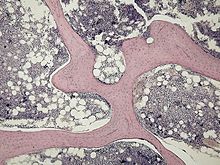
Micrograph of cancellous bone
Cancellous bone, likewise called trabecular or spongy bone,[10] is the internal tissue of the skeletal bone and is an open jail cell porous network that follows the textile properties of biofoams.[11] Cancellous bone has a higher surface-area-to-volume ratio than cortical bone and it is less dumbo. This makes it weaker and more flexible. The greater surface expanse also makes it suitable for metabolic activities such every bit the substitution of calcium ions. Cancellous bone is typically found at the ends of long basic, near joints and in the interior of vertebrae. Cancellous bone is highly vascular and frequently contains carmine bone marrow where hematopoiesis, the production of claret cells, occurs. The primary anatomical and functional unit of cancellous bone is the trabecula. The trabeculae are aligned towards the mechanical load distribution that a bone experiences within long bones such equally the femur. As far equally short bones are concerned, trabecular alignment has been studied in the vertebral pedicle.[12] Thin formations of osteoblasts covered in endosteum create an irregular network of spaces,[xiii] known as trabeculae. Within these spaces are os marrow and hematopoietic stem cells that requite rise to platelets, scarlet blood cells and white claret cells.[13] Trabecular marrow is composed of a network of rod- and plate-like elements that brand the overall organ lighter and allow room for blood vessels and marrow. Trabecular bone accounts for the remaining xx% of total os mass simply has well-nigh x times the surface expanse of compact os.[14]
The words cancellous and trabecular refer to the tiny lattice-shaped units (trabeculae) that form the tissue. It was first illustrated accurately in the engravings of Crisóstomo Martinez.[xv]
Marrow [edit]
Os marrow, also known as myeloid tissue in cherry-red bone marrow, can exist found in almost any bone that holds cancellous tissue. In newborns, all such basic are filled exclusively with red marrow or hematopoietic marrow, but equally the child ages the hematopoietic fraction decreases in quantity and the fat/ xanthous fraction called marrow adipose tissue (MAT) increases in quantity. In adults, scarlet marrow is mostly found in the bone marrow of the femur, the ribs, the vertebrae and pelvic bones.[16]
Cells [edit]

Bone is metabolically active tissue composed of several types of cells. These cells include osteoblasts, which are involved in the cosmos and mineralization of bone tissue, osteocytes, and osteoclasts, which are involved in the reabsorption of bone tissue. Osteoblasts and osteocytes are derived from osteoprogenitor cells, but osteoclasts are derived from the aforementioned cells that differentiate to class macrophages and monocytes.[17] Within the marrow of the bone in that location are besides hematopoietic stem cells. These cells give rise to other cells, including white blood cells, red claret cells, and platelets.[18]
Osteoblast [edit]

Light micrograph of decalcified cancellous os tissue displaying osteoblasts actively synthesizing osteoid, containing two osteocytes.
Osteoblasts are mononucleate bone-forming cells. They are located on the surface of osteon seams and make a protein mixture known every bit osteoid, which mineralizes to become os.[nineteen] The osteoid seam is a narrow region of newly formed organic matrix, not nevertheless mineralized, located on the surface of a os. Osteoid is primarily composed of Type I collagen. Osteoblasts also manufacture hormones, such as prostaglandins, to human action on the bone itself. The osteoblast creates and repairs new os past actually building around itself. First, the osteoblast puts up collagen fibers. These collagen fibers are used as a framework for the osteoblasts' work. The osteoblast then deposits calcium phosphate which is hardened by hydroxide and bicarbonate ions. The brand-new os created by the osteoblast is called osteoid.[20] Once the osteoblast is finished working information technology is actually trapped inside the os once it hardens. When the osteoblast becomes trapped, it becomes known equally an osteocyte. Other osteoblasts remain on the height of the new os and are used to protect the underlying bone, these become known equally lining cells.[ citation needed ]
Osteocyte [edit]
Osteocytes are cells of mesenchymal origin and originate from osteoblasts that have migrated into and go trapped and surrounded by os matrix that they themselves produced.[10] The spaces the cell body of osteocytes occupy within the mineralized collagen type I matrix are known as lacunae, while the osteocyte cell processes occupy channels called canaliculi. The many processes of osteocytes achieve out to meet osteoblasts, osteoclasts, bone lining cells, and other osteocytes probably for the purposes of communication.[21] Osteocytes remain in contact with other osteocytes in the bone through gap junctions—coupled cell processes which pass through the canalicular channels.
Osteoclast [edit]
Osteoclasts are very large multinucleate cells that are responsible for the breakdown of bones past the process of bone resorption. New bone is then formed by the osteoblasts. Os is constantly remodeled by the resorption of osteoclasts and created past osteoblasts.[17] Osteoclasts are large cells with multiple nuclei located on bone surfaces in what are called Howship's lacunae (or resorption pits). These lacunae are the outcome of surrounding bone tissue that has been reabsorbed.[22] Considering the osteoclasts are derived from a monocyte stem-jail cell lineage, they are equipped with phagocytic-similar mechanisms similar to circulating macrophages.[17] Osteoclasts mature and/or migrate to discrete bone surfaces. Upon arrival, active enzymes, such as tartrate-resistant acid phosphatase, are secreted confronting the mineral substrate.[ commendation needed ] The reabsorption of bone by osteoclasts likewise plays a role in calcium homeostasis.[22]
Composition [edit]
Basic consist of living cells (osteoblasts and osteocytes) embedded in a mineralized organic matrix. The primary inorganic component of homo bone is hydroxyapatite, the dominant bone mineral, having the nominal limerick of Ca10(POiv)6(OH)2.[23] The organic components of this matrix consist mainly of type I collagen—"organic" referring to materials produced every bit a consequence of the human body—and inorganic components, which alongside the dominant hydroxyapatite phase, include other compounds of calcium and phosphate including salts. Approximately 30% of the acellular component of bone consists of organic matter, while roughly 70% by mass is attributed to the inorganic phase.[24] The collagen fibers requite bone its tensile strength, and the interspersed crystals of hydroxyapatite give os its compressive force. These effects are synergistic.[24] The exact composition of the matrix may exist bailiwick to change over time due to nutrition and biomineralization, with the ratio of calcium to phosphate varying between 1.3 and 2.0 (per weight), and trace minerals such equally magnesium, sodium, potassium and carbonate as well being institute.[24]
Type I collagen composes 90–95% of the organic matrix, with remainder of the matrix existence a homogenous liquid chosen footing substance consisting of proteoglycans such as hyaluronic acid and chondroitin sulfate,[24] too as non-collagenous proteins such as osteocalcin, osteopontin or bone sialoprotein. Collagen consists of strands of repeating units, which give bone tensile strength, and are arranged in an overlapping fashion that prevents shear stress. The function of ground substance is not fully known.[24] Two types of bone tin be identified microscopically according to the arrangement of collagen: woven and lamellar.
- Woven bone (also known as fibrous bone), which is characterized past a haphazard organization of collagen fibers and is mechanically weak.[25]
- Lamellar os, which has a regular parallel alignment of collagen into sheets ("lamellae") and is mechanically strong.[25]
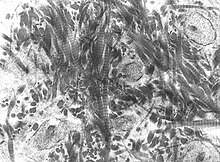
Woven os is produced when osteoblasts produce osteoid rapidly, which occurs initially in all fetal bones, merely is later replaced by more resilient lamellar bone. In adults woven bone is created after fractures or in Paget's disease. Woven bone is weaker, with a smaller number of randomly oriented collagen fibers, but forms quickly; it is for this appearance of the fibrous matrix that the os is termed woven. It is before long replaced by lamellar bone, which is highly organized in concentric sheets with a much lower proportion of osteocytes to surrounding tissue. Lamellar os, which makes its offset advent in humans in the fetus during the third trimester,[26] is stronger and filled with many collagen fibers parallel to other fibers in the same layer (these parallel columns are chosen osteons). In cross-section, the fibers run in opposite directions in alternating layers, much like in plywood, assisting in the bone'due south ability to resist torsion forces. Afterwards a fracture, woven bone forms initially and is gradually replaced past lamellar bone during a process known equally "bony substitution." Compared to woven bone, lamellar bone germination takes identify more slowly. The orderly deposition of collagen fibers restricts the formation of osteoid to about i to 2 µm per twenty-four hour period. Lamellar os as well requires a relatively flat surface to lay the collagen fibers in parallel or concentric layers.[27]
Deposition [edit]
The extracellular matrix of bone is laid down by osteoblasts, which secrete both collagen and basis substance. These synthesise collagen inside the cell and so secrete collagen fibrils. The collagen fibers rapidly polymerise to form collagen strands. At this stage, they are non yet mineralised, and are called "osteoid". Effectually the strands calcium and phosphate precipitate on the surface of these strands, within days to weeks becoming crystals of hydroxyapatite.[24]
In order to mineralise the bone, the osteoblasts secrete vesicles containing alkaline phosphatase. This cleaves the phosphate groups and acts every bit the foci for calcium and phosphate degradation. The vesicles then rupture and act as a center for crystals to grow on. More than peculiarly, bone mineral is formed from globular and plate structures.[28] [29]
Types [edit]

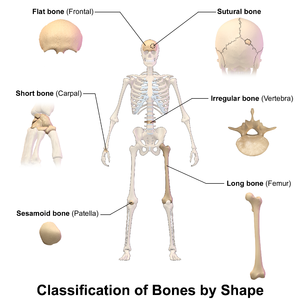
At that place are five types of bones in the human body: long, brusque, flat, irregular, and sesamoid.[30]
- Long bones are characterized by a shaft, the diaphysis, that is much longer than its width; and by an epiphysis, a rounded head at each end of the shaft. They are made up mostly of compact bone, with bottom amounts of marrow, located within the medullary cavity, and areas of spongy, cancellous os at the ends of the bones.[31] Nigh bones of the limbs, including those of the fingers and toes, are long basic. The exceptions are the eight carpal bones of the wrist, the seven articulating tarsal bones of the ankle and the sesamoid os of the kneecap. Long basic such every bit the clavicle, that have a differently shaped shaft or ends are also called modified long bones.
- Brusque bones are roughly cube-shaped, and accept simply a thin layer of compact bone surrounding a spongy interior. The bones of the wrist and ankle are curt basic.
- Flat bones are thin and generally curved, with two parallel layers of meaty bone sandwiching a layer of spongy os. Most of the bones of the skull are flat bones, every bit is the sternum.[32]
- Sesamoid bones are bones embedded in tendons. Since they human action to concur the tendon further away from the joint, the bending of the tendon is increased and thus the leverage of the muscle is increased. Examples of sesamoid bones are the patella and the pisiform.[33]
- Irregular bones do not fit into the above categories. They consist of thin layers of compact os surrounding a spongy interior. As implied by the name, their shapes are irregular and complicated. Oft this irregular shape is due to their many centers of ossification or considering they contain bony sinuses. The bones of the spine, pelvis, and some bones of the skull are irregular bones. Examples include the ethmoid and sphenoid bones.[34]
Terminology [edit]
In the study of beefcake, anatomists apply a number of anatomical terms to describe the appearance, shape and role of bones. Other anatomical terms are also used to describe the location of bones. Like other anatomical terms, many of these derive from Latin and Greek. Some anatomists however use Latin to refer to bones. The term "osseous", and the prefix "osteo-", referring to things related to bone, are still used commonly today.
Some examples of terms used to describe bones include the term "foramen" to draw a pigsty through which something passes, and a "culvert" or "meatus" to describe a tunnel-like structure. A protrusion from a os can be chosen a number of terms, including a "condyle", "crest", "spine", "eminence", "tubercle" or "tuberosity", depending on the protrusion's shape and location. In general, long basic are said to have a "head", "cervix", and "trunk".
When two bones bring together together, they are said to "articulate". If the ii bones accept a fibrous connection and are relatively immobile, then the joint is called a "suture".
Evolution [edit]
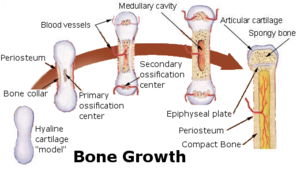
Endochondral ossification
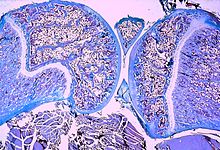
Light micrograph of a section through a juvenile knee joint articulation (rat) showing the cartilagineous growth plates
The germination of bone is chosen ossification. During the fetal phase of evolution this occurs past two processes: intramembranous ossification and endochondral ossification.[35] Intramembranous ossification involves the formation of bone from connective tissue whereas endochondral ossification involves the formation of bone from cartilage.
Intramembranous ossification mainly occurs during formation of the flat bones of the skull simply also the mandible, maxilla, and clavicles; the os is formed from connective tissue such equally mesenchyme tissue rather than from cartilage. The procedure includes: the development of the ossification center, calcification, trabeculae formation and the development of the periosteum.[36]
Endochondral ossification occurs in long bones and well-nigh other bones in the body; it involves the development of bone from cartilage. This process includes the evolution of a cartilage model, its growth and evolution, development of the primary and secondary ossification centers, and the formation of articular cartilage and the epiphyseal plates.[37]
Endochondral ossification begins with points in the cartilage called "primary ossification centers." They mostly appear during fetal development, though a few short basic begin their primary ossification after birth. They are responsible for the formation of the diaphyses of long basic, short bones and certain parts of irregular basic. Secondary ossification occurs afterward nascence and forms the epiphyses of long bones and the extremities of irregular and apartment basic. The diaphysis and both epiphyses of a long os are separated by a growing zone of cartilage (the epiphyseal plate). At skeletal maturity (xviii to 25 years of age), all of the cartilage is replaced past bone, fusing the diaphysis and both epiphyses together (epiphyseal closure).[38] In the upper limbs, only the diaphyses of the long bones and scapula are ossified. The epiphyses, carpal bones, coracoid process, medial border of the scapula, and acromion are still cartilaginous.[39]
The following steps are followed in the conversion of cartilage to os:
- Zone of reserve cartilage. This region, farthest from the marrow cavity, consists of typical hyaline cartilage that as yet shows no sign of transforming into bone.[twoscore]
- Zone of cell proliferation. A piddling closer to the marrow cavity, chondrocytes multiply and adjust themselves into longitudinal columns of flattened lacunae.[40]
- Zone of cell hypertrophy. Side by side, the chondrocytes cease to divide and begin to hypertrophy (enlarge), much like they do in the primary ossification middle of the fetus. The walls of the matrix between lacunae become very thin.[40]
- Zone of calcification. Minerals are deposited in the matrix between the columns of lacunae and calcify the cartilage. These are not the permanent mineral deposits of bone, simply only a temporary support for the cartilage that would otherwise soon be weakened past the breakup of the enlarged lacunae.[40]
- Zone of os deposition. Within each column, the walls between the lacunae break downwardly and the chondrocytes die. This converts each cavalcade into a longitudinal channel, which is immediately invaded by claret vessels and marrow from the marrow cavity. Osteoblasts line upward forth the walls of these channels and brainstorm depositing concentric lamellae of matrix, while osteoclasts dissolve the temporarily calcified cartilage.[40]
Functions [edit]
| Functions of bone |
|---|
Mechanical
|
Synthetic
|
Metabolic
|
Bones have a variety of functions:
Mechanical [edit]
Bones serve a variety of mechanical functions. Together the basic in the torso form the skeleton. They provide a frame to go along the body supported, and an attachment point for skeletal muscles, tendons, ligaments and joints, which function together to generate and transfer forces so that individual body parts or the whole torso tin be manipulated in three-dimensional space (the interaction between bone and musculus is studied in biomechanics).
Basic protect internal organs, such equally the skull protecting the brain or the ribs protecting the centre and lungs. Because of the way that bone is formed, os has a loftier compressive strength of about 170 MPa (1,700 kgf/cm2),[8] poor tensile strength of 104–121 MPa, and a very depression shear stress force (51.vi MPa).[41] [42] This means that bone resists pushing (compressional) stress well, resist pulling (tensional) stress less well, but only poorly resists shear stress (such as due to torsional loads). While bone is essentially brittle, bone does have a meaning degree of elasticity, contributed importantly by collagen.
Mechanically, bones too have a special role in hearing. The ossicles are 3 pocket-size bones in the middle ear which are involved in sound transduction.
Synthetic [edit]
The cancellous function of bones comprise os marrow. Os marrow produces blood cells in a process called hematopoiesis.[43] Blood cells that are created in bone marrow include scarlet blood cells, platelets and white blood cells.[44] Progenitor cells such as the hematopoietic stem cell divide in a procedure called mitosis to produce precursor cells. These include precursors which eventually give ascent to white blood cells, and erythroblasts which give ascent to red blood cells.[45] Unlike carmine and white blood cells, created by mitosis, platelets are shed from very large cells chosen megakaryocytes.[46] This process of progressive differentiation occurs inside the bone marrow. After the cells are matured, they enter the circulation.[47] Every day, over two.5 billion crimson blood cells and platelets, and 50–100 billion granulocytes are produced in this fashion.[18]
As well every bit creating cells, bone marrow is also one of the major sites where defective or anile red blood cells are destroyed.[18]
Metabolic [edit]
- Mineral storage – basic act as reserves of minerals important for the torso, most notably calcium and phosphorus.[48] [ commendation needed ] [49]
Determined by the species, age, and the type of bone, os cells make upwardly to 15 percentage of the bone. Growth cistron storage—mineralized bone matrix stores important growth factors such as insulin-similar growth factors, transforming growth cistron, bone morphogenetic proteins and others.[l]
- Fat storage – marrow adipose tissue (MAT) acts as a storage reserve of fatty acids.[51]
- Acid-base of operations residuum – bone buffers the claret against excessive pH changes by absorbing or releasing alkaline salts.[52]
- Detoxification – bone tissues can besides shop heavy metals and other foreign elements, removing them from the blood and reducing their effects on other tissues. These tin can later exist gradually released for excretion.[53]
- Endocrine organ – bone controls phosphate metabolism past releasing fibroblast growth cistron 23 (FGF-23), which acts on kidneys to reduce phosphate reabsorption. Bone cells also release a hormone called osteocalcin, which contributes to the regulation of blood sugar (glucose) and fatty degradation. Osteocalcin increases both the insulin secretion and sensitivity, in addition to boosting the number of insulin-producing cells and reducing stores of fatty.[54]
- Calcium rest – the process of bone resorption by the osteoclasts releases stored calcium into the systemic apportionment and is an important process in regulating calcium balance. Equally bone germination actively fixes circulating calcium in its mineral form, removing it from the bloodstream, resorption actively unfixes it thereby increasing circulating calcium levels. These processes occur in tandem at site-specific locations.[55]
Remodeling [edit]
Bone is constantly being created and replaced in a process known as remodeling. This ongoing turnover of bone is a process of resorption followed past replacement of bone with little alter in shape. This is achieved through osteoblasts and osteoclasts. Cells are stimulated by a variety of signals, and together referred to as a remodeling unit. Approximately 10% of the skeletal mass of an adult is remodelled each year.[56] The purpose of remodeling is to regulate calcium homeostasis, repair microdamaged bones from everyday stress, and to shape the skeleton during growth.[57] Repeated stress, such every bit weight-bearing exercise or os healing, results in the bone thickening at the points of maximum stress (Wolff's law). It has been hypothesized that this is a result of bone'south piezoelectric properties, which cause bone to generate small-scale electric potentials under stress.[58]
The action of osteoblasts and osteoclasts are controlled past a number of chemical enzymes that either promote or inhibit the activeness of the bone remodeling cells, controlling the rate at which bone is made, destroyed, or changed in shape. The cells besides use paracrine signalling to control the activity of each other.[59] [60] For instance, the rate at which osteoclasts resorb bone is inhibited by calcitonin and osteoprotegerin. Calcitonin is produced by parafollicular cells in the thyroid gland, and can bind to receptors on osteoclasts to directly inhibit osteoclast action. Osteoprotegerin is secreted by osteoblasts and is able to bind RANK-50, inhibiting osteoclast stimulation.[61]
Osteoblasts can also be stimulated to increase os mass through increased secretion of osteoid and by inhibiting the power of osteoclasts to suspension down osseous tissue.[ commendation needed ] Increased secretion of osteoid is stimulated by the secretion of growth hormone by the pituitary, thyroid hormone and the sexual practice hormones (estrogens and androgens). These hormones as well promote increased secretion of osteoprotegerin.[61] Osteoblasts tin also be induced to secrete a number of cytokines that promote reabsorption of bone by stimulating osteoclast activity and differentiation from progenitor cells. Vitamin D, parathyroid hormone and stimulation from osteocytes induce osteoblasts to increase secretion of RANK-ligand and interleukin six, which cytokines so stimulate increased reabsorption of bone by osteoclasts. These aforementioned compounds besides increase secretion of macrophage colony-stimulating factor by osteoblasts, which promotes the differentiation of progenitor cells into osteoclasts, and decrease secretion of osteoprotegerin.[ commendation needed ]
Book [edit]
Bone volume is determined by the rates of bone formation and bone resorption. Recent research has suggested that certain growth factors may piece of work to locally alter bone germination by increasing osteoblast action. Numerous bone-derived growth factors have been isolated and classified via bone cultures. These factors include insulin-like growth factors I and Ii, transforming growth factor-beta, fibroblast growth factor, platelet-derived growth factor, and bone morphogenetic proteins.[62] Evidence suggests that bone cells produce growth factors for extracellular storage in the os matrix. The release of these growth factors from the os matrix could cause the proliferation of osteoblast precursors. Substantially, bone growth factors may human activity equally potential determinants of local bone formation.[62] Enquiry has suggested that cancellous os volume in postmenopausal osteoporosis may exist determined by the human relationship between the total bone forming surface and the percent of surface resorption.[63]
Clinical significance [edit]
A number of diseases can touch os, including arthritis, fractures, infections, osteoporosis and tumors. Conditions relating to os tin can be managed by a variety of doctors, including rheumatologists for joints, and orthopedic surgeons, who may acquit surgery to gear up broken bones. Other doctors, such as rehabilitation specialists may exist involved in recovery, radiologists in interpreting the findings on imaging, and pathologists in investigating the cause of the disease, and family doctors may play a role in preventing complications of bone affliction such equally osteoporosis.
When a doctor sees a patient, a history and exam will be taken. Bones are then often imaged, called radiography. This might include ultrasound 10-ray, CT scan, MRI scan and other imaging such as a Bone scan, which may be used to investigate cancer.[64] Other tests such as a claret test for autoimmune markers may be taken, or a synovial fluid aspirate may be taken.[64]
Fractures [edit]

In normal bone, fractures occur when there is significant forcefulness practical or repetitive trauma over a long time. Fractures can also occur when a bone is weakened, such as with osteoporosis, or when there is a structural problem, such as when the bone remodels excessively (such as Paget's illness) or is the site of the growth of cancer.[65] Common fractures include wrist fractures and hip fractures, associated with osteoporosis, vertebral fractures associated with loftier-energy trauma and cancer, and fractures of long-bones. Not all fractures are painful.[65] When serious, depending on the fractures type and location, complications may include flail chest, compartment syndromes or fat embolism. Compound fractures involve the bone's penetration through the skin. Some circuitous fractures can be treated by the use of bone grafting procedures that replace missing bone portions.
Fractures and their underlying causes tin can be investigated by 10-rays, CT scans and MRIs.[65] Fractures are described past their location and shape, and several classification systems exist, depending on the location of the fracture. A mutual long os fracture in children is a Salter–Harris fracture.[66] When fractures are managed, pain relief is frequently given, and the fractured area is often immobilised. This is to promote bone healing. In addition, surgical measures such as internal fixation may be used. Because of the immobilisation, people with fractures are often advised to undergo rehabilitation.[65]
Tumors [edit]
There are several types of tumor that tin can touch bone; examples of beneficial bone tumors include osteoma, osteoid osteoma, osteochondroma, osteoblastoma, enchondroma, giant-prison cell tumor of bone, and aneurysmal os cyst.[67]
Cancer [edit]
Cancer tin ascend in bone tissue, and basic are too a common site for other cancers to spread (metastasise) to.[68] Cancers that arise in bone are called "primary" cancers, although such cancers are rare.[68] Metastases within bone are "secondary" cancers, with the most common beingness breast cancer, lung cancer, prostate cancer, thyroid cancer, and kidney cancer.[68] Secondary cancers that affect os can either destroy bone (called a "lytic" cancer) or create bone (a "sclerotic" cancer). Cancers of the bone marrow inside the bone tin also affect bone tissue, examples including leukemia and multiple myeloma. Bone may also be affected past cancers in other parts of the body. Cancers in other parts of the trunk may release parathyroid hormone or parathyroid hormone-related peptide. This increases os reabsorption, and tin pb to os fractures.
Bone tissue that is destroyed or altered as a result of cancers is distorted, weakened, and more prone to fracture. This may lead to compression of the spinal cord, destruction of the marrow resulting in bruising, haemorrhage and immunosuppression, and is one cause of bone hurting. If the cancer is metastatic, and then in that location might be other symptoms depending on the site of the original cancer. Some bone cancers can likewise be felt.
Cancers of the os are managed according to their type, their stage, prognosis, and what symptoms they cause. Many chief cancers of bone are treated with radiotherapy. Cancers of os marrow may exist treated with chemotherapy, and other forms of targeted therapy such every bit immunotherapy may exist used.[69] Palliative intendance, which focuses on maximising a person'southward quality of life, may play a role in management, particularly if the likelihood of survival inside v years is poor.
Other painful conditions [edit]
- Osteomyelitis is inflammation of the bone or bone marrow due to bacterial infection.[70]
- Osteomalacia is a painful softening of adult bone caused by severe vitamin D deficiency.[71]
- Osteogenesis imperfecta[72]
- Osteochondritis dissecans[73]
- Ankylosing spondylitis[74]
- Skeletal fluorosis is a bone disease caused by an excessive accumulation of fluoride in the basic. In avant-garde cases, skeletal fluorosis damages bones and joints and is painful.[75]
Osteoporosis [edit]
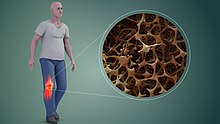
Reduced bone mineral density in Osteoporosis (R), increasing the likelihood of fractures
Osteoporosis is a illness of os where in that location is reduced bone mineral density, increasing the likelihood of fractures.[76] Osteoporosis is defined in women by the World Wellness Organization as a bone mineral density of two.v standard deviations below peak os mass, relative to the age and sex activity-matched average. This density is measured using dual free energy X-ray absorptiometry (DEXA), with the term "established osteoporosis" including the presence of a fragility fracture.[77] Osteoporosis is most common in women after menopause, when it is called "postmenopausal osteoporosis", just may develop in men and premenopausal women in the presence of item hormonal disorders and other chronic diseases or as a effect of smoking and medications, specifically glucocorticoids.[76] Osteoporosis normally has no symptoms until a fracture occurs.[76] For this reason, DEXA scans are often done in people with one or more risk factors, who have developed osteoporosis and are at risk of fracture.[76]
1 of the most important take chances factors for osteoporosis is advanced age. Accumulation of oxidative DNA damage in osteoblastic and osteoclastic cells appears to be a key cistron in age-related osteoporosis.[78]
Osteoporosis handling includes communication to finish smoking, decrease alcohol consumption, exercise regularly, and take a good for you diet. Calcium and trace mineral supplements may also exist brash, as may Vitamin D. When medication is used, it may include bisphosphonates, Strontium ranelate, and hormone replacement therapy.[79]
Osteopathic medicine [edit]
Osteopathic medicine is a school of medical thought originally developed based on the idea of the link between the musculoskeletal system and overall health, simply now very like to mainstream medicine. As of 2012[update], over 77,000 physicians in the The states are trained in osteopathic medical schools.[80]
Osteology [edit]

Human femurs and humerus from Roman menstruation, with prove of healed fractures
The study of bones and teeth is referred to as osteology. Information technology is ofttimes used in anthropology, archeology and forensic science for a multifariousness of tasks. This can include determining the nutritional, wellness, age or injury status of the individual the bones were taken from. Preparing fleshed bones for these types of studies can involve the procedure of maceration.
Typically anthropologists and archeologists study bone tools made past Homo sapiens and Homo neanderthalensis. Bones tin can serve a number of uses such as projectile points or creative pigments, and can also be fabricated from external bones such as antlers.
Other animals [edit]


Leg and pelvic girdle bones of bird
Bird skeletons are very lightweight. Their bones are smaller and thinner, to assistance flight. Amid mammals, bats come closest to birds in terms of bone density, suggesting that pocket-size dumbo bones are a flight adaptation. Many bird basic have petty marrow due to them being hollow.[81]
A bird's nib is primarily made of bone as projections of the mandibles which are covered in keratin.
Some bones, primarily formed separately in subcutaneous tissues, include headgears (such as bony cadre of horns, antlers, ossicones), osteoderm, and os penis/ os clitoris.[82] A deer's antlers are composed of bone which is an unusual instance of bone being outside the skin of the animal once the velvet is shed.[83]
The extinct predatory fish Dunkleosteus had sharp edges of hard exposed bone along its jaws.[84] [85]
The proportion of cortical bone that is fourscore% in the homo skeleton may be much lower in other animals, particularly in marine mammals and marine turtles, or in various Mesozoic marine reptiles, such as ichthyosaurs,[86] amidst others.[87] This proportion can vary quickly in evolution; it often increases in early stages of returns to an aquatic lifestyle, equally seen in early whales and pinnipeds, among others. It afterward decreases in pelagic taxa, which typically acquire spongy bone, but aquatic taxa that alive in shallow h2o can retain very thick, pachyostotic,[88] osteosclerotic, or pachyosteosclerotic[89] basic, especially if they motility slowly, like bounding main cows. In some cases, even marine taxa that had caused spongy bone tin revert to thicker, compact bones if they become adjusted to alive in shallow water, or in hypersaline (denser) h2o.[90] [91] [92]
Many animals, particularly herbivores, practice osteophagy—the eating of bones. This is presumably carried out in order to furnish lacking phosphate.
Many bone diseases that affect humans likewise impact other vertebrates—an case of one disorder is skeletal fluorosis.
Club and culture [edit]
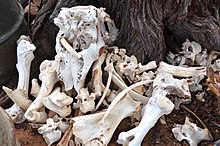
Bones from slaughtered animals have a number of uses. In prehistoric times, they take been used for making os tools.[93] They accept further been used in bone carving, already of import in prehistoric fine art, and besides in modern fourth dimension as crafting materials for buttons, beads, handles, bobbins, calculation aids, head nuts, dice, poker fries, pick-upward sticks, arrows, scrimshaw, ornaments, etc.
Bone glue can be made by prolonged boiling of ground or cracked bones, followed past filtering and evaporation to thicken the resulting fluid. Historically one time important, os glue and other animal glues today have simply a few specialized uses, such equally in antiques restoration. Essentially the same process, with further refinement, thickening and drying, is used to make gelatin.
Broth is made by simmering several ingredients for a long time, traditionally including bones.
Bone char, a porous, blackness, granular fabric primarily used for filtration and likewise as a black pigment, is produced past charring mammal bones.
Oracle bone script was a writing system used in Aboriginal Red china based on inscriptions in bones. Its proper name originates from oracle basic, which were mainly ox clavicle. The Ancient Chinese (mainly in the Shang dynasty), would write their questions on the oracle os, and burn the bone, and where the bone cracked would be the answer for the questions.
To point the bone at someone is considered bad luck in some cultures, such as Australian aborigines, such as past the Kurdaitcha.
The wishbones of fowl have been used for divination, and are still customarily used in a tradition to determine which i of two people pulling on either prong of the bone may make a wish.
Diverse cultures throughout history accept adopted the custom of shaping an infant's head past the practice of artificial cranial deformation. A widely practised custom in China was that of foot bounden to limit the normal growth of the foot.
Boosted images [edit]
-
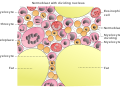
Cells in bone marrow
-

Scanning electron microscope of bone at 100× magnification
-
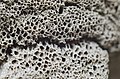
Structure detail of an animal bone
Meet too [edit]
- Bogus bone
- Bone wellness
- Distraction osteogenesis
- National Bone Health Campaign
- Skeleton
References [edit]
- ^ Lee, Cassandra. "The Bone Organ Arrangement: Course and Office". Science Direct . Retrieved thirty January 2022.
- ^ de Buffrénil, Vivian; de Ricqlès, Armand J; Zylberberg, Louise; Padian, Kevin; Laurin, Michel; Quilhac, Alexandra (2021). Vertebrate skeletal histology and paleohistology (Firstiton ed.). Boca Raton, FL: CRC Printing. pp. xii + 825. ISBN978-1351189576.
- ^ "How Many Bones Does a Baby Accept and Why Do Adults Have Fewer?". Healthline. 26 June 2019. Retrieved 19 July 2021.
- ^ Steele, D. Gentry; Claud A. Bramblett (1988). The Anatomy and Biological science of the Homo Skeleton . Texas A&Chiliad Academy Press. p. 4. ISBN978-0-89096-300-5.
- ^ Mammal anatomy : an illustrated guide. New York: Marshall Cavendish. 2010. p. 129. ISBN9780761478829.
- ^ "ossein". The Gratuitous Dictionary.
- ^ Hall, John (2011). Textbook of Medical Physiology (12th ed.). Philadelphia: Elsevier. pp. 957–960. ISBN978-08089-2400-5.
- ^ a b Schmidt-Nielsen, Knut (1984). Scaling: Why Is Brute Size So Important?. Cambridge: Cambridge Academy Press. p. six. ISBN978-0-521-31987-4.
- ^ "Construction of Bone". flexbooks.ck12.org. CK12-Foundation. Retrieved 28 May 2020.
- ^ a b c Deakin 2006, p. 192.
- ^ Meyers, Marc André; Chen, Po-Yu; Lin, Albert Yu-Min; Seki, Yasuaki (1 January 2008). "Biological materials: Structure and mechanical properties". Progress in Materials Scientific discipline. 53 (i): 1–206. doi:10.1016/j.pmatsci.2007.05.002. ISSN 0079-6425.
- ^ Gdyczynski, C.Grand.; Manbachi, A.; et al. (2014). "On estimating the directionality distribution in pedicle trabecular bone from micro-CT images". Physiological Measurement. 35 (12): 2415–2428. Bibcode:2014PhyM...35.2415G. doi:x.1088/0967-3334/35/12/2415. PMID 25391037.
- ^ a b Deakin 2006, p. 195.
- ^ Hall, Susan J. (2007). Basic Biomechanics with OLC (fifth ed., Revised. ed.). Burr Ridge: McGraw-Hill Higher Pedagogy. p. 88. ISBN978-0-07-126041-one.
- ^ Gomez, Santiago (February 2002). "Crisóstomo Martinez, 1638–1694: the discoverer of trabecular os". Endocrine. 17 (1): iii–4. doi:10.1385/ENDO:17:1:03. ISSN 1355-008X. PMID 12014701. S2CID 46340228.
- ^ Barnes-Svarney, Patricia L.; Svarney, Thomas E. (2016). The Handy Anatomy Reply Book : Includes Physiology. Detroit: Visible Ink Printing. pp. 90–91. ISBN9781578595426.
- ^ a b c Deakin 2006, p. 189.
- ^ a b c Deakin 2006, p. 58.
- ^ Deakin 2006, pp. 189–190.
- ^ Washington. "The O' Cells." Bone Cells. Academy of Washington, n.d. Web. iii Apr. 2013.
- ^ Sims, Natalie A.; Vrahnas, Christina (2014). "Regulation of cortical and trabecular os mass past communication betwixt osteoblasts, osteocytes and osteoclasts". Archives of Biochemistry and Biophysics. 561: 22–28. doi:x.1016/j.abb.2014.05.015. PMID 24875146.
- ^ a b Deakin 2006, p. 190.
- ^ Enhancement of Hydroxyapatite Dissolution Journal of Materials Scientific discipline & Engineering science,38, 148-158
- ^ a b c d e f Hall 2005, p. 981.
- ^ a b Currey, John D. (2002). "The Structure of Bone Tissue", pp. 12–14 in Bones: Structure and Mechanics. Princeton University Press. Princeton, NJ. ISBN 9781400849505
- ^ Salentijn, L. Biology of Mineralized Tissues: Cartilage and Bone, Columbia University College of Dental Medicine mail service-graduate dental lecture serial, 2007
- ^ Royce, Peter M.; Steinmann, Shell (xiv April 2003). Connective Tissue and Its Heritable Disorders: Molecular, Genetic, and Medical Aspects. John Wiley & Sons. ISBN978-0-471-46117-3.
- ^ Bertazzo, S.; Bertran, C. A. (2006). "Morphological and dimensional characteristics of bone mineral crystals". Bioceramics. 309–311 (Pt. 1, ii): 3–10. doi:ten.4028/www.scientific.net/kem.309-311.3. S2CID 136883011.
- ^ Bertazzo, S.; Bertran, C.A.; Camilli, J.A. (2006). "Morphological Characterization of Femur and Parietal Bone Mineral of Rats at Unlike Ages". Primal Engineering Materials. 309–311: eleven–fourteen. doi:x.4028/www.scientific.net/kem.309-311.xi. S2CID 135813389.
- ^ "Types of bone". mananatomy.com. Retrieved 6 February 2016.
- ^ "DoITPoMS – TLP Library Structure of bone and implant materials – Structure and limerick of bone". www.doitpoms.ac.uk.
- ^ Bart Clarke (2008), "Normal Bone Anatomy and Physiology", Clinical Journal of the American Gild of Nephrology, 3 (Suppl 3): S131–S139, doi:ten.2215/CJN.04151206, PMC3152283, PMID 18988698
- ^ Adriana Jerez; Susana Mangione; Virginia Abdala (2010), "Occurrence and distribution of sesamoid basic in squamates: a comparative approach", Acta Zoologica, 91 (3): 295–305, doi:10.1111/j.1463-6395.2009.00408.x
- ^ Pratt, Rebecca. "Bone every bit an Organ". AnatomyOne. Amirsys, Inc. Archived from the original on 30 October 2019. Retrieved 28 September 2012.
- ^ OpenStax, Anatomy & Physiology. OpenStax CNX. Feb 26, 2016 http://cnx.org/contents/14fb4ad7-39a1-4eee-ab6e-3ef2482e3e22@8.24
- ^ "Bone Growth and Development | Biology for Majors 2". courses.lumenlearning.com . Retrieved 28 May 2020.
- ^ Tortora, Gerard J.; Derrickson, Bryan H. (2018). Principles of Anatomy and Physiology. John Wiley & Sons. ISBN978-1-119-44445-9.
- ^ "vi.4B: Postnatal Bone Growth". Medicine LibreTexts. nineteen July 2018. Retrieved 28 May 2020.
- ^ Agur, Anne (2009). Grant's Atlas of Anatomy. Philadelphia: Lippincott, Williams, and Wilkins. p. 598. ISBN978-0-7817-7055-ii.
- ^ a b c d due east Saladin, Kenneth (2012). Beefcake and Physiology: The Unity of Form and Role. New York: McGraw-Hill. p. 217. ISBN978-0-07-337825-1.
- ^ Vincent, Kevin. "Topic 3: Structure and Mechanical Properties of Bone". BENG 112A Biomechanics, Wintertime Quarter, 2013. Department of Bioengineering, University of California. Archived from the original on 28 May 2018. Retrieved 24 March 2015.
- ^ Turner, C.H.; Wang, T.; Burr, D.B. (2001). "Shear Force and Fatigue Properties of Human Cortical Bone Determined from Pure Shear Tests". Calcified Tissue International. 69 (6): 373–378. doi:10.1007/s00223-001-1006-1. PMID 11800235. S2CID 30348345.
- ^ Fernández, KS; de Alarcón, PA (December 2013). "Development of the hematopoietic arrangement and disorders of hematopoiesis that present during infancy and early on babyhood". Pediatric Clinics of North America. 60 (half dozen): 1273–1289. doi:10.1016/j.pcl.2013.08.002. PMID 24237971.
- ^ Deakin 2006, pp. threescore–61.
- ^ Deakin 2006, p. 60.
- ^ Deakin 2006, p. 57.
- ^ Deakin 2006, p. 46.
- ^ Doyle, Máire Due east.; Jan de Beur, Suzanne M. (2008). "The Skeleton: Endocrine Regulator of Phosphate Homeostasis". Current Osteoporosis Reports. 6 (four): 134–141. doi:x.1007/s11914-008-0024-half-dozen. PMID 19032923. S2CID 23298442.
- ^ Walker, Kristin. "Bone". Encyclopedia Britannica . Retrieved v October 2017.
- ^ Pv, Hauschka; Tl, Chen; Ae, Mavrakos (1988). "Polypeptide Growth Factors in Bone Matrix". Ciba Foundation Symposium. Novartis Foundation Symposia. 136: 207–225. doi:x.1002/9780470513637.ch13. ISBN9780470513637. PMID 3068010. Retrieved 28 May 2020.
- ^ Styner, Maya; Pagnotti, Gabriel 1000; McGrath, Cody; Wu, Xin; Sen, Buer; Uzer, Gunes; Xie, Zhihui; Zong, Xiaopeng; Styner, Martin A (1 May 2017). "Exercise Decreases Marrow Adipose Tissue through β-Oxidation in Obese Running Mice". Journal of Bone and Mineral Research. 32 (8): 1692–1702. doi:ten.1002/jbmr.3159. ISSN 1523-4681. PMC5550355. PMID 28436105.
- ^ Fogelman, Ignac; Gnanasegaran, Gopinath; Wall, Hans van der (2013). Radionuclide and Hybrid Bone Imaging. Springer. ISBN978-3-642-02400-9.
- ^ "Os". flipper.diff.org . Retrieved 28 May 2020.
- ^ Lee, Na Kyung; et al. (10 August 2007). "Endocrine Regulation of Energy Metabolism by the Skeleton". Jail cell. 130 (3): 456–469. doi:10.1016/j.cell.2007.05.047. PMC2013746. PMID 17693256.
- ^ Foundation, CK-12. "Bones". world wide web.ck12.org . Retrieved 29 May 2020.
- ^ Manolagas, SC (April 2000). "Birth and death of bone cells: basic regulatory mechanisms and implications for the pathogenesis and handling of osteoporosis". Endocrine Reviews. 21 (two): 115–137. doi:x.1210/edrv.21.2.0395. PMID 10782361.
- ^ Hadjidakis DJ, Androulakis Two (31 January 2007). "Bone remodeling". Annals of the New York Academy of Sciences. 1092: 385–396. doi:10.1196/register.1365.035. PMID 17308163. S2CID 39878618. Retrieved xviii May 2020.
- ^ ed, Russell T. Woodburne ..., consulting (1999). Anatomy, physiology, and metabolic disorders (5. impress. ed.). Summit, N.J.: Novartis Pharmaceutical Corp. pp. 187–189. ISBN978-0-914168-88-1.
- ^ Fogelman, Ignac; Gnanasegaran, Gopinath; Wall, Hans van der (2013). Radionuclide and Hybrid Bone Imaging. Springer. ISBN978-3-642-02400-nine.
- ^ "Introduction to jail cell signaling (commodity)". Khan Academy . Retrieved 24 December 2020.
- ^ a b Boulpaep, Emile L.; Boron, Walter F. (2005). Medical physiology: a cellular and molecular approach. Philadelphia: Saunders. pp. 1089–1091. ISBN978-1-4160-2328-9.
- ^ a b Baylink, D. J. (1991). "Bone growth factors". Clinical Orthopaedics and Related Research. 263 (263): 30–48. doi:10.1097/00003086-199102000-00004. PMID 1993386.
- ^ Nordin, Be; Aaron, J; Speed, R; Crilly, RG (8 Baronial 1981). "Bone formation and resorption as the determinants of trabecular bone volume in postmenopausal osteoporosis". Lancet. ii (8241): 277–279. doi:10.1016/S0140-6736(81)90526-ii. PMID 6114324. S2CID 29646037.
- ^ a b Davidson 2010, pp. 1059–1062.
- ^ a b c d Davidson 2010, p. 1068.
- ^ Salter RB, Harris WR (1963). "Injuries Involving the Epiphyseal Plate". J Bone Articulation Surg Am. 45 (3): 587–622. doi:10.2106/00004623-196345030-00019. Archived from the original on 2 Dec 2016. Retrieved ii December 2016.
- ^ "Benign Os Tumours". Cleveland Dispensary. 2017. Retrieved 29 March 2017.
- ^ a b c Davidson 2010, p. 1125.
- ^ Davidson 2010, p. 1032.
- ^ "Osteomyelitis". The Lecturio Medical Concept Library . Retrieved 26 August 2021.
- ^ "Osteomalacia and Rickets". The Lecturio Medical Concept Library . Retrieved 26 Baronial 2021.
- ^ "Osteogenesis Imperfecta". The Lecturio Medical Concept Library . Retrieved 26 August 2021.
- ^ "Osteochondritis Dissecans". The Lecturio Medical Concept Library . Retrieved 26 August 2021.
- ^ "Ankylosing Spondylitis". The Lecturio Medical Concept Library . Retrieved 26 Baronial 2021.
- ^ Whitford GM (1994). "Intake and Metabolism of Fluoride". Advances in Dental Research. viii (one): 5–xiv. doi:ten.1177/08959374940080011001. PMID 7993560. S2CID 21763028.
- ^ a b c d Davidson 2010, pp. 1116–1121.
- ^ WHO (1994). "Assessment of fracture gamble and its application to screening for postmenopausal osteoporosis. Report of a WHO Study Group". Earth Health Organization Technical Written report Series. 843: 1–129. PMID 7941614.
- ^ Chen Q, Liu K, Robinson AR, et al. DNA damage drives accelerated bone aging via an NF-κB-dependent machinery. J Bone Miner Res. 2013;28(v):1214-1228. doi:10.1002/jbmr.1851
- ^ Davidson 2010, pp. 1116–1121
- ^ "2012 Osteopathic Medical Profession Report" (PDF). Osteopathic.org. American Osteopathic Arrangement. Archived from the original (PDF) on sixteen June 2013. Retrieved 26 November 2014.
- ^ Dumont, E. R. (17 March 2010). "Bone density and the lightweight skeletons of birds". Proceedings of the Royal Society B: Biological Sciences. 277 (1691): 2193–2198. doi:10.1098/rspb.2010.0117. PMC2880151. PMID 20236981.
- ^ Nasoori, A (2020). "Formation, structure, and office of actress‐skeletal basic in mammals". Biological Reviews. 95 (4): 986–1019. doi:ten.1111/brv.12597. PMID 32338826. S2CID 216556342.
- ^ Hans J. Rolf; Alfred Enderle (1999). "Hard fallow deer antler: a living bone till antler casting?". The Anatomical Record. 255 (i): 69–77. doi:10.1002/(SICI)1097-0185(19990501)255:i<69::Aid-AR8>3.0.CO;2-R. PMID 10321994.
- ^ "Dunkleosteus". American Museum of Natural History.
- ^ "My, What a Big Mouth You Have | Cleveland Museum of Natural History".
- ^ de Buffrénil V.; Mazin J.-Thou. (1990). "Bone histology of the ichthyosaurs: comparative data and functional interpretation". Paleobiology. 16 (iv): 435–447. doi:10.1017/S0094837300010174. JSTOR 2400968.
- ^ Laurin, M.; Canoville, A.; Germain, D. (2011). "Bone microanatomy and lifestyle: a descriptive approach". Comptes Rendus Palevol. 10 (v–6): 381–402. doi:10.1016/j.crpv.2011.02.003.
- ^ Houssaye, Alexandra; De Buffrenil, Vivian; Rage, Jean-Claude; Bardet, Nathalie (12 September 2008). "An analysis of vertebral 'pachyostosis' in Carentonosaurus mineaui (Mosasauroidea, Squamata) from the Cenomanian (early Tardily Cretaceous) of France, with comments on its phylogenetic and functional significance". Periodical of Vertebrate Paleontology. 28 (iii): 685–691. doi:x.1671/0272-4634(2008)28[685:AAOVPI]2.0.CO;2. ISSN 0272-4634. S2CID 129670238.
- ^ de Buffrénil, Vivian; Canoville, Aurore; D'Anastasio, Ruggero; Domning, Daryl P. (June 2010). "Evolution of Sirenian Pachyosteosclerosis, a Model-instance for the Study of Bone Construction in Aquatic Tetrapods". Periodical of Mammalian Evolution. 17 (2): 101–120. doi:10.1007/s10914-010-9130-1. S2CID 39169019.
- ^ Dewaele, Leonard; Lambert, Olivier; Laurin, Michel; De Kock, Tim; Louwye, Stephen; de Buffrénil, Vivian (December 2019). "Generalized Osteosclerotic Status in the Skeleton of Nanophoca vitulinoides, a Dwarf Seal from the Miocene of Belgium". Journal of Mammalian Evolution. 26 (iv): 517–543. doi:x.1007/s10914-018-9438-nine. S2CID 20885865.
- ^ Dewaele, Leonard; Gol'din, Pavel; Marx, Felix G.; Lambert, Olivier; Laurin, Michel; Obadă, Theodor; Buffrénil, Vivian de (10 January 2022). "Hypersalinity drives convergent bone mass increases in Miocene marine mammals from the Paratethys". Electric current Biological science. 32 (i): 248–255.e2. doi:x.1016/j.cub.2021.10.065. ISSN 0960-9822. PMID 34813730. S2CID 244485732.
- ^ Houssaye, Alexandra (10 January 2022). "Evolution: Back to heavy basic in salty seas". Current Biology. 32 (1): R42–R44. doi:10.1016/j.cub.2021.11.049. PMID 35015995. S2CID 245879886.
- ^ Laszlovszky, J¢zsef; Szab¢, P‚ter (1 Jan 2003). People and Nature in Historical Perspective. Central European University Press. ISBN978-963-9241-86-2.
Footnotes [edit]
- Katja Hoehn; Marieb, Elaine Nicpon (2007). Human Anatomy & Physiology (seventh ed.). San Francisco: Benjamin Cummings. ISBN978-0-8053-5909-one.
- Bryan H. Derrickson; Tortora, Gerard J. (2005). Principles of anatomy and physiology. New York: Wiley. ISBN978-0-471-68934-8.
- Davidson, Stanley (2010). Colledge, Nicki R.; Walker, Brian R.; Ralston, Stuart H. (eds.). Davidson's principles and do of medicine. Illustrated by Robert Britton (21st ed.). Edinburgh: Churchill Livingstone/Elsevier. ISBN978-0-7020-3085-7.
- Deakin, Barbara Immature; et al. (2006). Wheater's functional histology : a text and colour atlas (fifth ed.). [Edinburgh?]: Churchill Livingstone/Elsevier. ISBN978-0-443-068-508. – drawings past Philip J.
- Hall, Arthur C.; Guyton, John E. (2005). Textbook of medical physiology (11th ed.). Philadelphia: West.B. Saunders. ISBN978-0-7216-0240-0.
- Anthony, S. Fauci; Harrison, T.R.; et al. (2008). Harrison's principles of internal medicine (17th ed.). New York [etc.]: McGraw-Loma Medical. ISBN978-0-07-147692-8. – Anthony edits the current version; Harrison edited previous versions.
External links [edit]
 | Wikimedia Eatables has media related to Bones. |
 | Wikiquote has quotations related to Bone . |
- Educational resources materials (including animations) past the American Society for Bone and Mineral Research
- Review (including references) of piezoelectricity and os remodelling
- A good bones overview of bone biological science from the Science Artistic Quarterly
- Usha Kini; B. Due north. Nandeesh (3 January 2013). "Ch 2: Physiology of Bone Formation, Remodeling, and Metabolism" (PDF). In Ignac Fogelman; Gopinath Gnanasegaran; Hans van der Wall (eds.). Radionuclide and hybrid bone imaging. Berlin: Springer. pp. 29–57. ISBN978-3-642-02399-6. Archived from the original (PDF) on 6 November 2020. Retrieved 28 August 2017.
- Bone histology photomicrographs
Source: https://en.wikipedia.org/wiki/Bone
Posted by: turnagethinthey.blogspot.com
0 Response to "What Are Two Types Of Bones Based On Cellular Makeup"
Post a Comment